
AI + Human Marketing: Why the Combination Matters in 2026
Artificial intelligence is changing the way businesses approach digital marketing in 2026. From content creation and customer research to advertising, SEO, analytics, and marketing automation, AI tools can help marketers complete tasks faster and process large amounts of information.
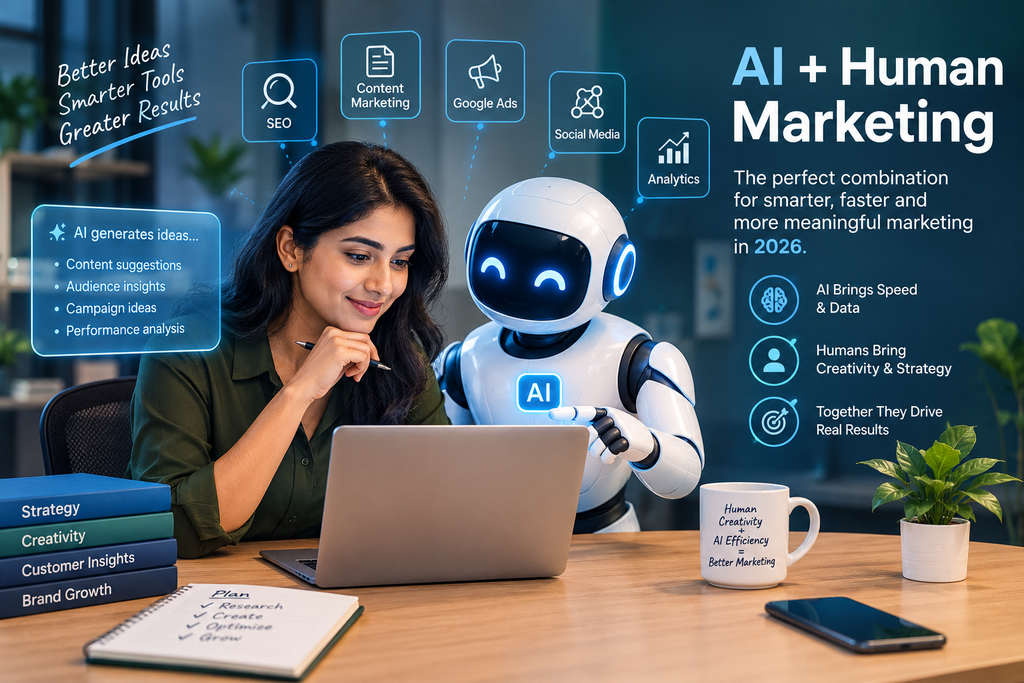
However, AI alone is not a complete marketing strategy. The most effective approach is increasingly AI + human marketing, where artificial intelligence handles data-heavy and repetitive tasks while human marketers provide creativity, strategic thinking, empathy, judgment, and brand understanding.
For businesses, the goal is not simply to replace traditional marketing with AI. Instead, the opportunity is to combine AI marketing tools with human expertise to create marketing that is faster, more relevant, more creative, and more valuable to customers.
What Is AI + Human Marketing?
AI + human marketing is a collaborative approach where marketers use artificial intelligence to support their work while humans remain responsible for strategy, creativity, decisions, and quality control.
AI can analyze large datasets, identify patterns, generate ideas, summarize information, create content drafts, and automate repetitive workflows. Human marketers can then review these outputs, add experience and context, improve the messaging, and make decisions based on business objectives.
This combination creates a workflow where AI provides efficiency and humans provide direction.
For example, AI can generate ten potential social media ideas in seconds. A human marketer can select the ideas that actually fit the brand, modify the messaging, add a unique perspective, and decide which content should be published.
This approach is especially important because Google’s current guidance emphasizes valuable, unique, people-first content and says established SEO fundamentals remain relevant for generative AI search experiences.
Why AI Alone Is Not Enough for Marketing
AI can process information quickly, but marketing involves more than producing information.
Successful marketing requires understanding people, businesses, emotions, culture, customer expectations, brand identity, and market context. These factors can be difficult to evaluate using automated systems alone.
AI-generated content can also require human review for accuracy, originality, tone, and brand alignment. Google specifically warns against creating large amounts of unoriginal content primarily to manipulate search rankings, regardless of whether AI or another method was used to create it.
Human marketers therefore play an important role in turning AI-generated information into useful marketing assets.
AI Can Help With
- Market and competitor research
- Keyword and topic research
- Content ideas
- First drafts
- Data analysis
- Campaign reporting
- Audience segmentation
- Ad variations
- Marketing automation
- Customer communication workflows
Humans Add
- Creativity
- Strategic thinking
- Brand voice
- Emotional intelligence
- Industry expertise
- Critical thinking
- Quality control
- Ethical judgment
- Final decision-making
The combination creates a more balanced marketing process.
How AI + Human Marketing Works
A practical AI marketing workflow can be divided into five stages.
1. Research With AI
AI tools can help marketers organize large amounts of information quickly. Marketers can use AI to identify common customer questions, analyze competitors, summarize market research, and discover potential content topics.
However, the human marketer should validate the information and decide which insights are actually relevant to the business.
2. Create With AI
AI can help generate blog outlines, social media ideas, advertising variations, email drafts, product descriptions, and other marketing materials.
Instead of publishing the first AI-generated version, marketers should treat it as a starting point.
Human editing can add real examples, business experience, customer insights, and a distinctive brand voice.
3. Review With Humans
This is one of the most important stages of AI + human marketing.
A human should review AI-generated content for:
- Accuracy
- Relevance
- Brand consistency
- Originality
- Grammar
- Customer intent
- Potential misinformation
- Legal or ethical concerns
Human review helps ensure that marketing content is not simply technically correct but also useful and appropriate for the intended audience.
4. Launch Marketing Campaigns
AI can support campaign planning by generating different messaging options, analyzing historical performance, and helping marketers organize campaign data.
Humans still need to decide the campaign objective, audience, positioning, creative direction, budget priorities, and overall marketing strategy.
5. Analyze and Improve
After a campaign launches, AI can help identify patterns in performance data.
For example, marketers can use AI to analyze:
- Website traffic
- Conversion rates
- Ad performance
- Customer engagement
- Search visibility
- Social media performance
- Email engagement
Humans can then interpret the findings and decide what changes should be made.
AI + Human Marketing for SEO
SEO is another area where AI and human expertise can work together.
AI can help with keyword research, content outlines, competitor analysis, content briefs, internal-link ideas, and identifying potential content gaps.
However, simply producing large volumes of AI-generated articles is not a sustainable SEO strategy.
Google’s current generative-AI guidance recommends creating valuable, non-commodity content with a unique point of view and focusing on what users find helpful and satisfying.
That means marketers should use AI to support SEO rather than replace SEO strategy.
A strong workflow could look like:
AI research → Human strategy → AI-assisted drafting → Human editing → SEO optimization → Publishing → Performance analysis
This approach can help businesses maintain efficiency without sacrificing content quality.
AI + Human Marketing for Social Media
Social media marketing is another area where collaboration between AI and humans can be valuable.
AI can generate content ideas, captions, hooks, posting concepts, and variations for different platforms. It can also help marketers analyze engagement patterns.
But successful social media marketing requires personality.
Customers often respond to authenticity, storytelling, humor, emotion, opinions, and experiences. Human marketers understand the brand personality and audience context needed to create these elements effectively.
For example, an AI tool might suggest a generic promotional caption. A human marketer can transform that idea into a story based on a real customer problem or business experience.
The result can be more natural and brand-specific.
AI + Human Marketing for Google Ads and Paid Advertising
AI can also support paid advertising by generating multiple ad-copy variations and helping marketers analyze campaign data.
For example, marketers can use AI to create different headline concepts, descriptions, audience messages, and creative ideas.
Humans should then evaluate whether the messaging matches the brand and customer intent.
The human role becomes particularly important when deciding:
- Campaign objectives
- Target audiences
- Brand positioning
- Offers
- Messaging
- Budget allocation
- Creative direction
- Conversion strategy
AI can accelerate the process, but business strategy still needs human direction.
The Importance of Human Creativity in AI Marketing
Creativity remains an important part of digital marketing.
AI can produce many variations quickly, but human marketers can provide experiences, opinions, emotions, cultural understanding, and original ideas.
A campaign becomes more memorable when it connects with something meaningful to the audience.
For example, AI can help generate a campaign concept, but a human creative team can connect that concept with a brand’s story, customer experience, visual identity, and emotional message.
This is why AI should be viewed as a creative collaborator, not simply a content replacement system.
Building Trust With AI + Human Marketing
Trust is increasingly important as AI-generated content becomes more common.
Businesses need to ensure that their content is accurate, transparent, useful, and aligned with their brand values.
Human oversight helps identify inaccurate information, inappropriate messaging, repetitive content, and statements that could damage customer trust.
AI governance and human oversight are also becoming important as businesses use AI across more marketing workflows. IBM’s recent marketing and AI research highlights the role of human supervision in maintaining reliability, brand integrity, and responsible use.
Benefits of Combining AI and Human Expertise
When businesses combine AI with human marketing expertise, they can potentially improve several parts of their workflow.
Faster Content Production
AI can reduce the time required for research, brainstorming, outlining, and first drafts.
Better Data Analysis
AI can process large amounts of marketing information and identify patterns that may be difficult to spot manually.
More Marketing Ideas
AI can generate multiple concepts that marketers can evaluate and develop.
Greater Efficiency
Repetitive tasks can be automated, allowing marketing teams to spend more time on strategy and creativity.
Stronger Brand Control
Human review helps ensure that AI-generated content remains consistent with the company’s voice and positioning.
How Businesses Can Build an AI + Human Marketing Strategy
Businesses can start with a simple approach.
Step 1: Identify repetitive tasks.
Find marketing activities that consume significant time but do not require constant human decision-making.
Step 2: Introduce AI tools.
Use AI for research, brainstorming, analysis, drafting, and automation where appropriate.
Step 3: Establish human review.
Define which tasks require human approval before publishing or execution.
Step 4: Create brand guidelines.
Document your brand voice, messaging, visual identity, audience, and communication standards.
Step 5: Measure performance.
Track traffic, engagement, leads, conversions, advertising performance, and other relevant KPIs.
Step 6: Improve continuously.
Use performance data and human feedback to refine your AI-assisted marketing workflow.
The Future of Marketing Is Human + AI
AI will continue to influence digital marketing in 2026 and beyond. Marketing teams are likely to use AI for increasingly sophisticated research, automation, content production, analytics, personalization, and campaign support.
At the same time, human expertise remains important because businesses still need people who understand customers, brands, creativity, strategy, and context.
The future is therefore not simply about AI versus humans.
It is about AI + human marketing.
Businesses that use AI to improve efficiency while keeping humans responsible for strategy, creativity, quality, and meaningful customer communication can build a more balanced marketing system.
Conclusion
AI is becoming an important part of modern digital marketing, but technology alone does not create great marketing.
The strongest approach is to combine the speed and analytical capabilities of AI with the creativity, experience, judgment, and empathy of human marketers.
From SEO and content marketing to Google Ads, social media, analytics, and automation, AI can support marketers across the customer journey. Humans can then transform those capabilities into strategies that are relevant to real customers and aligned with real business goals.
In 2026, the question is not whether businesses should choose AI or human marketing.
The bigger opportunity is learning how to make AI and human expertise work together effectively.