
GEO vs SEO: Why Businesses Are Talking About Generative Search
Search is changing faster than ever. For years, businesses focused on SEO (Search Engine Optimization) to improve Google rankings, attract organic traffic, and generate leads. Today, another term is becoming increasingly common in digital marketing conversations: GEO, or Generative Engine Optimization.
The discussion around GEO vs SEO has grown because people are increasingly using AI-powered search experiences to find information, compare businesses, discover products, and answer questions. Instead of simply displaying a list of blue links, generative search can provide a conversational answer based on information gathered from multiple sources.
This creates a new challenge for businesses: How can your brand become visible when customers search through AI-powered experiences?
The answer is not necessarily to choose GEO instead of SEO. In practice, businesses can use SEO as a foundation while adapting their content, brand presence, and authority for generative search.
What Is SEO?
SEO, or Search Engine Optimization, is the process of improving a website so that it can appear prominently in traditional search engine results.
SEO involves several important areas, including:
- Keyword research
- Search intent
- On-page optimization
- Technical SEO
- Internal linking
- Backlinks
- Website performance
- Mobile usability
- High-quality content
- Structured data
The objective is to help search engines understand your website and connect your pages with relevant searches.
For example, a digital marketing agency targeting the keyword “SEO services in Chennai” may create a dedicated service page optimized around that search intent.
SEO remains important even as generative search grows. Google’s current guidance states that its existing SEO best practices continue to be relevant for appearing in generative AI features such as AI Overviews and AI Mode.
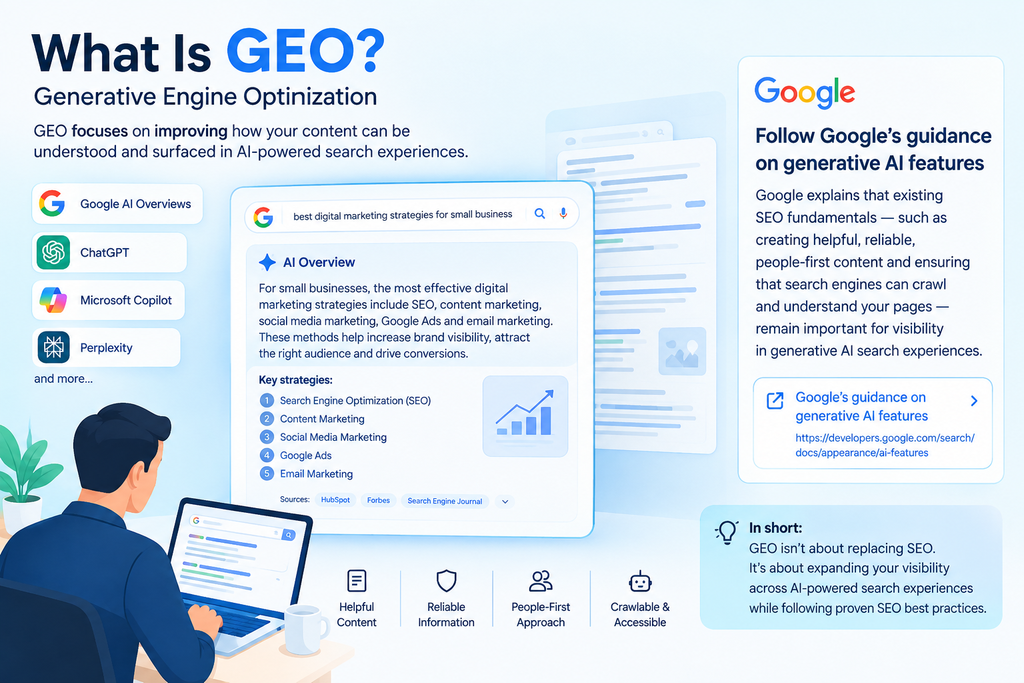
What Is GEO?
GEO stands for Generative Engine Optimization.
GEO refers to strategies designed to improve the likelihood that a business, website, product, or brand is mentioned, referenced, or cited in AI-generated answers.
Generative search platforms can include experiences such as:
- Google AI Overviews
- Google AI Mode
- ChatGPT
- Microsoft Copilot
- Perplexity
- Other AI-powered search experiences
Instead of asking only, “How can I rank number one?”, GEO introduces another question:
“How can my business become a trusted source in an AI-generated answer?”
Industry discussions increasingly describe GEO as an extension of search visibility rather than a complete replacement for traditional SEO.
GEO vs SEO: What Is the Difference?
The simplest way to understand GEO vs SEO is to look at where the visibility happens.
| SEO | GEO |
|---|---|
| Focuses on traditional search visibility | Focuses on generative search visibility |
| Targets search engine results | Targets AI-generated answers and citations |
| Emphasizes rankings and organic traffic | Emphasizes mentions, citations and AI visibility |
| Uses keywords and search intent | Uses context, entities and answer-focused content |
| Builds authority through links and content | Builds authority through trusted content and wider brand presence |
| Measures rankings, clicks and traffic | Can include AI mentions, citations and referral traffic |
However, these strategies overlap significantly.
A technically strong website, useful content, clear information architecture, and trustworthy sources can support both SEO and GEO.
Why Are Businesses Talking About Generative Search?
Generative search changes the way people interact with information.
Instead of searching:
“best digital marketing agency”
and opening several websites, a user may ask an AI system:
“What should I look for when choosing a digital marketing agency for a small business?”
The system can then provide a detailed response based on information it retrieves or already has access to.
This means the traditional customer journey is becoming more conversational.
Search is moving from:
Keywords → Questions → Conversations → Answers
For businesses, this means being visible in the answer can become another important part of digital marketing.
Does GEO Replace SEO?
No. Businesses should not treat GEO vs SEO as an either-or decision.
Google’s documentation specifically emphasizes that SEO fundamentals remain relevant for generative AI search experiences. It also recommends creating valuable, unique, people-first content rather than focusing on content created primarily to manipulate search systems.
Think of SEO as the foundation.
GEO adds another layer focused on how information is discovered, interpreted, summarized, and potentially cited by generative systems.
A strong strategy can therefore combine:
Technical SEO + Quality Content + Brand Authority + AI Search Optimization
How Generative Search Changes Content Marketing
Traditional SEO content often targets specific keywords.
For example:
“Digital Marketing Services”
With generative search, businesses should also consider the questions users might ask around that topic.
Examples include:
- What does a digital marketing agency do?
- How much does digital marketing cost?
- Which digital marketing strategy is best for a small business?
- How can SEO generate leads?
- What is the difference between SEO and Google Ads?
Creating content that answers these questions clearly can make your website more useful to both people and search systems.
Create Direct Answers
Avoid making readers search through several paragraphs to find the answer.
Use:
- Clear H2 and H3 headings
- Short paragraphs
- Bullet points
- Definitions
- Examples
- Tables
- Step-by-step explanations
This structure also makes important information easier to understand and extract.
Build Topical Authority
One article is rarely enough to establish strong expertise around a competitive subject.
Instead, businesses can build topic clusters.
For example, a digital marketing website could create a central SEO page supported by articles about:
- On-page SEO
- Technical SEO
- Local SEO
- Keyword research
- SEO content writing
- AI SEO
- GEO
- Zero-click search
- Search intent
- Internal linking
These related pages help create a deeper content ecosystem.
Focus on Original Information
One of the biggest opportunities in generative search is creating content that offers something genuinely useful.
Google’s guidance for generative AI search emphasizes valuable, non-commodity content and a unique point of view.
Instead of simply rewriting information already available online, businesses can publish:
- Original research
- Customer insights
- Case studies
- Industry data
- Expert opinions
- Original examples
- Proprietary processes
- Real-world experiences
For example, an agency could publish a case study explaining how a particular SEO strategy affected impressions, leads, or conversions.
Build Brand Authority Beyond Your Website
GEO is not only about optimizing your own website.
AI systems can encounter information about brands across different sources. That makes a broader digital presence valuable.
Businesses should maintain consistent information across:
- Business directories
- Industry publications
- Social platforms
- Review platforms
- Professional communities
- Relevant third-party websites
The objective is to create a clear and consistent understanding of what your business does.
Use Structured Data and Technical SEO
Technical SEO remains important in an AI-driven search environment.
Make sure your website has:
- Crawlable pages
- Logical site architecture
- Internal links
- Descriptive page titles
- Useful headings
- Mobile-friendly pages
- Fast and stable experiences
- Accurate structured data
Google explains that structured data can help it understand page content and can support eligibility for certain search features.
Technical optimization does not guarantee AI citations, but it helps create a strong foundation for search visibility.
How to Measure GEO Performance
SEO has established metrics such as:
- Keyword rankings
- Organic traffic
- Click-through rate
- Impressions
- Conversions
- Backlinks
GEO introduces additional visibility questions.
Businesses can monitor:
- Brand mentions in AI answers
- AI citations
- Referral traffic from AI platforms
- Branded searches
- Visibility for important customer questions
- Conversion activity from AI-referred visitors
Measurement is still developing, and industry research notes that AI-search attribution and visibility measurement can be difficult because AI answers can vary between queries and over time.
GEO and SEO Should Work Together
The GEO vs SEO conversation can sometimes make these strategies sound like competitors.
A more practical approach is to combine them.
Your SEO strategy can help establish:
Technical foundation → Search visibility → Content authority
Your GEO strategy can extend that into:
AI visibility → Brand mentions → Citations → Generative discovery
Together, these strategies help businesses prepare for a search environment where customers may discover brands through traditional search engines, AI answers, social platforms, and conversational tools.
What Businesses Should Do Now
Businesses preparing for generative search should focus on the fundamentals first.
Step 1: Improve Your Website
Make sure your website is technically accessible, mobile-friendly, fast, and easy to navigate.
Step 2: Understand Search Intent
Identify the questions customers ask before purchasing your product or service.
Step 3: Create Helpful Content
Answer those questions with original, accurate, useful information.
Step 4: Strengthen Authority
Build credible mentions, references, reviews, backlinks, and industry relationships.
Step 5: Optimize for AI Search
Make important information clear, structured, factual, and easy to understand.
Step 6: Monitor Visibility
Track traditional SEO performance alongside emerging AI-search visibility signals.
The Future of Search Is About Visibility
The future of search is unlikely to be simply SEO versus GEO.
Traditional search results and generative AI experiences are increasingly existing alongside one another. Current industry research also describes SEO and GEO as overlapping strategies rather than completely separate disciplines.
For businesses, the bigger objective is search visibility.
Your potential customers may discover your brand through:
- Google search results
- AI Overviews
- AI Mode
- ChatGPT
- Perplexity
- Social media
- Business directories
- Online communities
The businesses that consistently provide useful information, establish authority, and maintain a strong digital presence can create more opportunities to be discovered across these environments.
Conclusion
The GEO vs SEO discussion reflects a major change in how people discover information online.
SEO continues to provide the technical and content foundation businesses need for search visibility. GEO adds another layer by considering how brands and information appear within generative search experiences.
Rather than abandoning SEO, businesses can strengthen their SEO foundation while adapting their content for AI-powered discovery.
The goal is simple:
Create useful content. Build authority. Make information easy to understand. Strengthen your brand presence. Optimize for the way customers search today.
As generative search continues to develop, businesses that treat SEO and AI search visibility as connected parts of a broader digital marketing strategy can prepare for a changing search landscape.